Table of Contents
- 1. Introduction
- 2. What is a CIBIL Score?
- 3. Who Calculates Your CIBIL Score?
- 4. How Does CIBIL Score Work? (Flow Diagram)
- 5. How Is a CIBIL Score Calculated?
- 6. Factors Affecting CIBIL Score
- 7. CIBIL Score Range Explained
- 8. How Banks Use Your CIBIL Score
- 9. Most Common Reasons Why Scores Drop
- 10. Most Common Reasons Scores Improve
- 11. How Long Does It Take to Improve?
- 12. How Often Is a CIBIL Score Updated?
- 13. Common Myths
- 14. How to Read Your Credit Report
- 15. Common Credit Report Errors
- 16. Step-by-Step Credit Improvement Plan
- 17. Real-Life Case Studies
- 18. When Should You Seek Professional Help?
- 19. NIDEE's 4-Step Credit Support Process
- 20. Expert Tips
- 21. FAQs
- 22. Conclusion
Quick Answer: How does a CIBIL score work?
A CIBIL score is a three-digit number between 300-900 that reflects your creditworthiness. It is calculated based on your credit report, which contains your loan repayment history, credit card usage, outstanding debts, and enquiries. Lenders use this score to assess loan eligibility and interest rates.
1. Introduction
You have probably heard about CIBIL score. Maybe you checked it once. But do you really understand how it works?
Most people only think about their CIBIL score when they apply for a loan and get rejected. Suddenly, the score becomes very important. But by then, it is often too late.
Whether you are applying for a home loan, personal loan, business loan, or credit card, your CIBIL score plays a crucial role. It affects not just whether you get the loan, but also the interest rate you pay.
In this complete guide, we will explain everything you need to know about how the CIBIL score works. We will cover how it is calculated, what factors affect it, how lenders use it, and most importantly—how you can improve it responsibly.
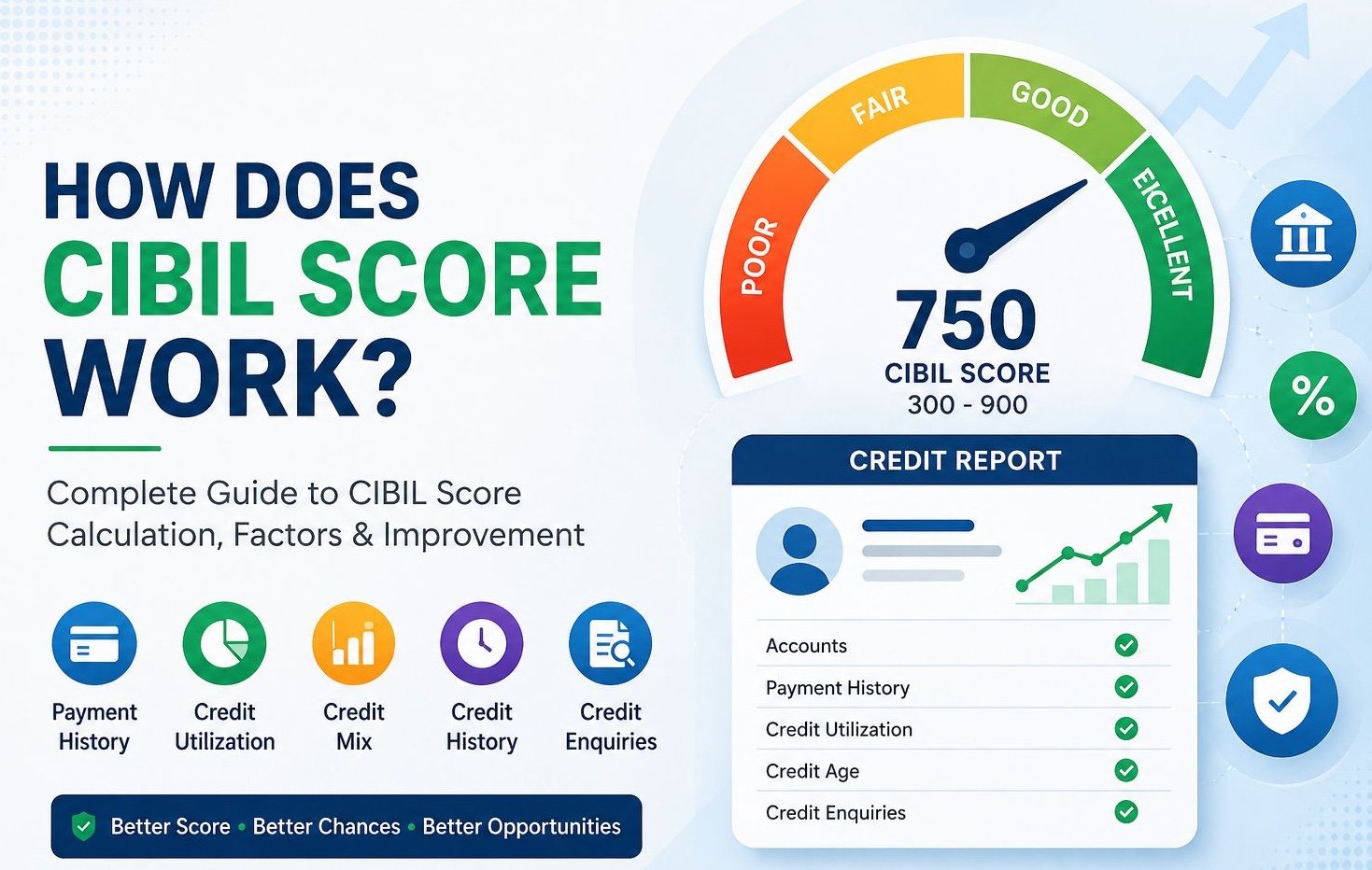
2. What is a CIBIL Score?
CIBIL Score is a three-digit number that represents your creditworthiness. It ranges from 300 to 900. A higher score means you are seen as a lower risk by lenders.
Purpose: The score helps lenders quickly assess your likelihood of repaying a loan.
Who uses it: Banks, NBFCs, credit card companies, and even some landlords and employers.
| Credit Score | Credit Report | Credit History | Credit Behaviour |
|---|---|---|---|
| Three-digit number (300-900) | Detailed document with all your credit accounts | Your track record of borrowing and repaying | Your habits—paying on time, using credit responsibly |
| Summary of your creditworthiness | Contains loans, credit cards, payment history, enquiries | Length of your credit journey | How you manage your finances |
3. Who Calculates Your CIBIL Score?
Your CIBIL score is calculated by credit bureaus. In India, there are four major credit bureaus:
- CIBIL (TransUnion CIBIL)
- Experian
- Equifax
- CRIF High Mark
How data reaches the bureau: Banks and NBFCs report your loan and credit card information to these bureaus every month. This includes your payment history, outstanding balance, account status, and more.
Reporting cycle: Most lenders report data once a month. The bureau updates your score after receiving new data.
4. How Does CIBIL Score Work? (Flow Diagram)
How it works step by step:
- You take a loan: You borrow money from a bank or NBFC.
- You repay (or don't): Your repayment behaviour is tracked.
- Data is reported: The lender reports your data to the credit bureau.
- Bureau creates your report: Your credit report is compiled.
- Score is calculated: The bureau uses an algorithm to calculate your score.
- Lender reviews: When you apply for a loan, the lender checks your score and report.
- Decision is made: Based on your score and other factors, the lender decides.
5. How Is a CIBIL Score Calculated?
Your CIBIL score is calculated using a complex algorithm. But it is based on five key factors. Let us understand each one.
Payment History
Weight: 35%
This is the most important factor. Do you pay your EMIs and credit card bills on time? One missed payment can drop your score by 50-100 points.
Example: If you have 10 loans and miss 1 EMI, that is a 10% miss rate. It signals risk to lenders.
Credit Utilization
Weight: 30%
How much of your available credit are you using? Using more than 30% of your credit limit is considered risky.
Example: If your credit card limit is ₹1,00,000 and your balance is ₹80,000, your utilization is 80%. This reduces your score.
Credit Mix
Weight: 15%
Do you have a mix of secured loans (home loan, car loan) and unsecured loans (personal loan, credit card)? A healthy mix is good.
Example: Having only personal loans and credit cards is less favorable than having a home loan plus a credit card.
Credit Age
Weight: 10%
How long have you been using credit? A longer credit history is better because it gives lenders more data.
Example: A person with 10 years of credit history is seen as more reliable than someone with 1 year.
Credit Enquiries
Weight: 10%
How many hard enquiries have you had in the last 6-12 months? Too many applications signal that you are desperate for credit.
Example: Applying for 5 loans in 3 months creates 5 hard enquiries, which can reduce your score.
6. Factors Affecting CIBIL Score
On-time payments, low utilization (below 30%), healthy credit mix, old credit accounts, few enquiries.
Missed payments, high utilization (above 50%), too many new accounts, too many enquiries, settlements, written-offs.
Checking your own score, soft enquiries, small loans, old enquiries.
7. CIBIL Score Range Explained
| Score Range | Category | What It Means |
|---|---|---|
| 800 – 900 | Excellent | Very high likelihood of loan approval. Best interest rates. |
| 750 – 799 | Good | Most loans get approved. Competitive interest rates. |
| 650 – 749 | Average | May get loans with higher interest or stricter terms. |
| 550 – 649 | Needs Improvement | Loan approval is difficult. Need to take corrective steps. |
| 300 – 549 | Poor | Very low chance of loan approval. Urgent credit repair needed. |
Important: Lenders also consider other factors like income, repayment capacity, and existing obligations. A high score does not guarantee approval.
8. How Banks Use Your CIBIL Score
- Loan eligibility: They check if you meet the minimum score requirement.
- Credit cards: They decide your credit limit based on your score.
- Interest negotiation: A better score can get you a lower interest rate.
- Loan amount: Higher scores often mean higher loan amounts.
- Risk assessment: They use your score to assess the risk of lending to you.
- Documentation: A good score might mean less documentation.
- Income verification: They compare your score with your income.
- Business loans: Your personal CIBIL score matters for business loans too.
- Mortgage loans: Home loans require a good score for approval.
- Education loans: A good score helps you get an education loan.
- Gold loans: Even gold loans are easier to get with a good score.
9. Most Common Reasons Why Scores Drop
- Missed EMI payments
- Late credit card payments
- High credit card utilization (above 50%)
- Too many loan applications
- Too many hard enquiries
- Loan settlement
- Written-off accounts
- Old outstanding dues
- Errors in credit report
- Short credit history
- Too much unsecured debt
- High existing EMI burden
- Being a guarantor on a defaulted loan
- Inactive credit monitoring
- Identity theft
- Closing old credit cards
- Maxing out credit cards
- Filing for bankruptcy
- Defaults
- Incorrect report information
10. Most Common Reasons Scores Improve
- Paying all EMIs on time
- Paying credit card bills in full and on time
- Keeping credit utilization below 30%
- Reducing outstanding debt
- Checking credit report for errors
- Disputing and correcting errors
- Maintaining a healthy credit mix
- Having a long credit history
- Avoiding multiple loan applications
- Not closing old credit cards
- Using credit cards responsibly
- Paying more than the minimum due
- Setting up auto-debits for EMIs
- Monitoring credit regularly
- Clearing old outstanding dues
- Avoiding settlements
- Building a good repayment track record
- Limiting hard enquiries
- Improving financial discipline
- Seeking professional guidance
11. How Long Does It Take to Improve a CIBIL Score?
There is no fixed timeline. It depends on the reason for your low score.
- Correcting errors: 15-30 days after the dispute is resolved.
- Reducing utilization: 1-2 months after you reduce your balance.
- Improving payment history: 3-6 months of consistent on-time payments.
- After settlement: It can take 12-24 months of good behaviour.
- After written-off: It can take 24-36 months of good behaviour.
Important: There is no guaranteed timeline. Focus on consistent positive behaviour.
12. How Often Is a CIBIL Score Updated?
- Monthly updates: Most lenders report data to bureaus every month.
- Bureau updates: The bureau updates your score after receiving new data.
- When to check: Check your score after 30-45 days of making a payment.
- Dispute updates: If you file a dispute, the bureau will update your report after investigation.
13. Common Myths
14. How to Read Your Credit Report
- Personal details: Your name, PAN, date of birth, and address. Verify these carefully.
- Contact information: Your mobile number and email.
- Loan accounts: All your loans (home, personal, auto). Check the lender, amount, and status.
- Credit cards: All your credit cards. Check the limit, balance, and payment history.
- Repayment history: Month-by-month payment status (0 = on time, 1 = 30 days late, 2 = 60 days late, 3 = 90+ days late).
- Outstanding balances: What you still owe on each account.
- Account status: Active, Closed, Settled, Written-Off.
- Enquiries: Who has checked your report and when.
15. Common Credit Report Errors
- Unknown loans: Loans you never took.
- Wrong balances: Outstanding amount is incorrect.
- Wrong PAN: Your PAN is linked to someone else.
- Duplicate accounts: Same loan appears twice.
- Closed loans active: A loan you closed is still showing as active.
- Wrong enquiries: Enquiries you did not authorize.
16. Step-by-Step Credit Improvement Plan
Week 1: Assessment
- Get your credit report from all four bureaus.
- Review it for errors.
- Note down all discrepancies.
Week 2: Correct Errors
- Gather supporting documents.
- File disputes with the bureaus.
- Track dispute status.
Week 3: Reduce Debt
- Pay down credit card balances.
- Reduce utilization below 30%.
- Pay off small loans.
Week 4: Build Positive Habits
- Set up auto-debits for EMIs.
- Pay credit card bills in full.
- Avoid new loan applications.
17. Real-Life Case Studies
Situation: Salaried employee missed one EMI.
Problem: Score dropped by 60 points.
Analysis: The late payment was reported.
Recommendation: Set up auto-debit, pay on time moving forward.
Situation: Used 80% of credit card limit.
Problem: Score dropped by 40 points.
Analysis: High utilization signaled risk.
Recommendation: Reduce balance, increase limit if possible.
Situation: A loan appeared that was never taken.
Problem: Score dropped due to high debt.
Analysis: Identity theft or error.
Recommendation: Dispute the account, file a complaint.
Situation: Loan closed 2 years ago still active.
Problem: Score lower than expected.
Analysis: Lender did not update status.
Recommendation: Dispute with closure letter.
Situation: Payment made on time marked late.
Problem: Score dropped by 50 points.
Analysis: Reporting error.
Recommendation: Dispute with bank statement.
Situation: Applied for 5 loans in 3 months.
Problem: Score dropped by 30 points.
Analysis: Desperation signal.
Recommendation: Stop applying for 6 months.
Situation: Settled a loan 1 year ago.
Problem: Score in the 600s.
Analysis: Settlement is negative.
Recommendation: Build positive history on other accounts.
Situation: First credit card 6 months ago.
Problem: Score in the 700s but limited.
Analysis: Not enough data.
Recommendation: Continue responsible usage, wait.
18. When Should You Seek Professional Help?
- You have multiple errors in your report.
- You are unsure about the accuracy of your report.
- You have been rejected for loans.
- You have a settlement or written-off account.
- You want a personalized improvement plan.
- You do not have time to manage disputes yourself.
- You want expert guidance on improving your credit profile.
19. NIDEE's 4-Step Credit Support Process
- Consultation: We understand your situation and goals.
- Analysis: We review your credit report thoroughly.
- Implementation: We guide you through corrections and improvements.
- Progress Review: We track your progress and adjust the plan.
20. Expert Tips
- Check your credit report at least twice a year.
- Always pay your EMIs and credit card bills on time.
- Keep your credit utilization below 30%.
- Maintain a healthy mix of secured and unsecured loans.
- Do not close old credit cards.
- Avoid applying for multiple loans at once.
- Review your report for errors regularly.
- Dispute errors as soon as you find them.
- Keep records of all loan closures.
- Set up auto-debits for your EMIs.
- Pay more than the minimum due on credit cards.
- Monitor your credit score monthly.
- Reduce your overall debt burden.
- Avoid loan settlements if possible.
- Be cautious about standing as a guarantor.
- Use credit cards for small, regular purchases.
- Do not max out your credit cards.
- Maintain a budget and track your spending.
- Seek professional help if you are unsure.
- Be patient—credit improvement takes time.
- Understand that your score is a reflection of your financial habits.
- Do not believe in quick-fix credit repair schemes.
- Focus on building a positive credit history.
- Educate yourself about credit and finance.
- Review your report from all four bureaus.
21. Frequently Asked Questions
1. How does CIBIL score work? +
2. How is CIBIL score calculated? +
3. What is a good CIBIL score? +
4. Can I improve my CIBIL score in 30 days? +
5. Does checking my own score reduce it? +
6. How many enquiries are too many? +
7. Does a settled loan affect my score? +
8. How long does a late payment stay on my report? +
9. Can I remove a genuine late payment? +
10. What is the difference between CIBIL and Experian? +
11. Does income affect CIBIL score? +
12. Can I get a loan with a score of 650? +
13. What is a hard enquiry? +
14. What is a soft enquiry? +
15. How do I get my credit report? +
16. What is credit utilization? +
17. Does closing a credit card help? +
18. What is a credit mix? +
19. How long does it take to improve score after settlement? +
20. Can I improve my score without taking a loan? +
21. What is the minimum score for a home loan? +
22. Does a written-off account affect my score? +
23. Can I dispute an error online? +
24. How does credit age affect my score? +
25. When should I check my CIBIL score? +
22. Conclusion
Understanding how the CIBIL score works is the first step toward building a strong credit profile. It is not just about the number—it is about the habits and behaviours that create that number.
Your CIBIL score reflects your financial discipline. Pay your bills on time. Keep your debt under control. Monitor your report regularly. And if you find errors, correct them.
Remember, there is no shortcut to a good credit score. It takes time, consistency, and responsible financial behaviour. But the rewards—better loan terms, lower interest rates, and financial freedom—are worth it.